Why salmon populations surge after dam removals
For more than a century, the Elwha River in Washington's Olympic Peninsula ran as two stagnant lakes held back by aging concrete. The dams, built in 1913 and 1927, had strangled one of the most productive salmon watersheds in the Pacific Northwest.
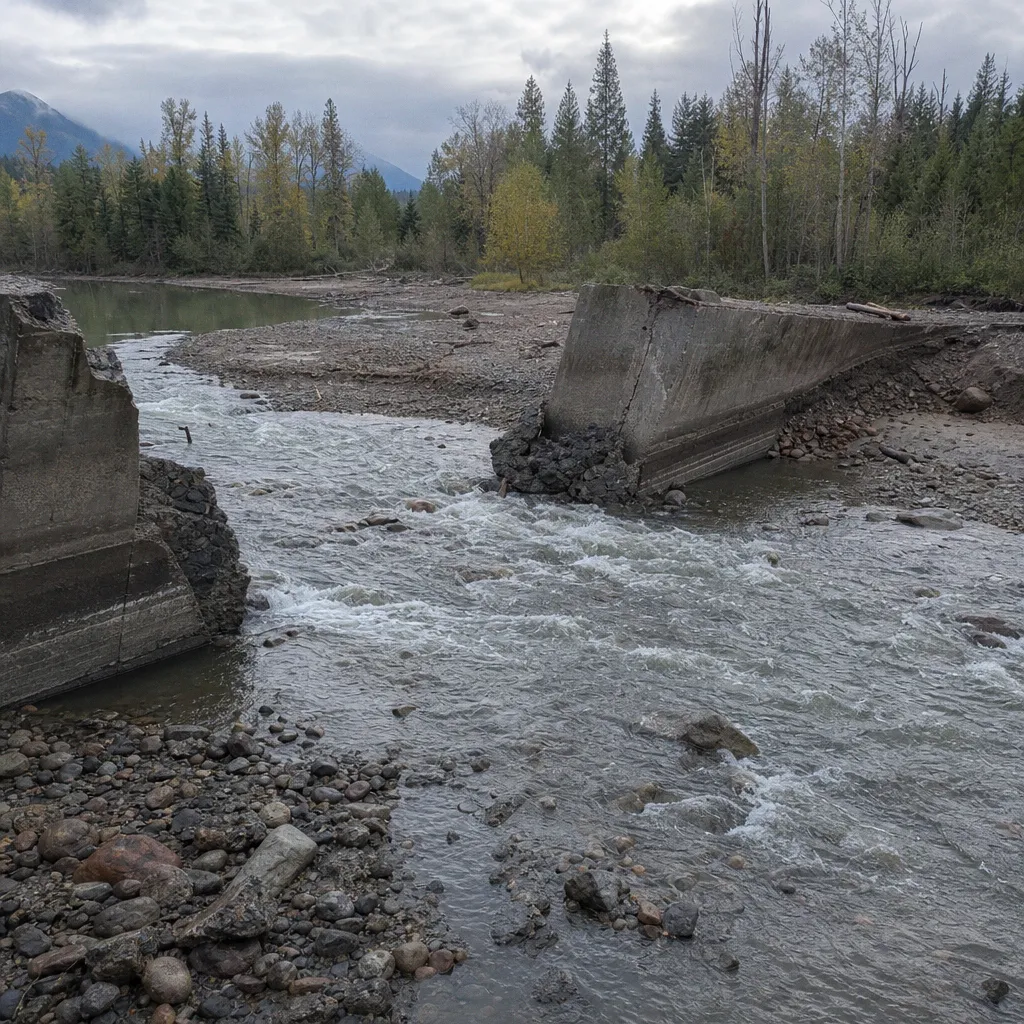
# When the River Remembers: Why Salmon Populations Surge After Dam Removals
Then, between 2011 and 2014, the dams came down. What happened next reads less like a fisheries report and more like a forgotten chapter of the river's own memory. By 2019, Chinook had constructed more than 4,000 redds in stretches that had been silent for a hundred years, and the fish had recolonized roughly 90 percent of their historical spawning range. The same story, with variations and asterisks, is now playing out on the Penobscot, the Sandy, the Coweeman, the White Salmon, and most dramatically of all on the Klamath, where the largest dam removal in world history is unfolding in real time.
So why do salmon populations surge after dam removals, often faster than the most optimistic models predict? The answer is layered, woven from hydrology, evolution, chemistry, and a kind of ecological time travel. Below, I'll walk through the mechanisms—physical, biological, chemical, and human—that turn a defatted river into a salmon nursery in a handful of seasons.
The river's first breath: what changes the moment the concrete goes
When a dam is removed, the river doesn't simply resume its old job. It rediscovers it. Sediment that had piled behind the impoundment for decades suddenly flows downstream; gravel that had been starved from the channel bed returns. The water column, once stratified and slow, becomes turbulent, oxygenated, and cool. None of this is incidental. Each shift corresponds to a specific thing a wild salmon needs to spawn, hatch, and grow.
The first measurable effect is usually a flush of fine sediment. This sounds like pollution, but it is actually housekeeping. The reservoir had been holding back sand and silt for decades, and when those particles are released, the river scours its own bed, uncovering cobble and gravel that had been buried and compacted. Spawning salmon need loose, well-oxygenated gravel to build their redds. Within weeks of a major removal, surveys typically show new gravel bars forming on riffles that had been empty for half a century. A 2017 study of the Elwha found that the river's median bed grain size increased by roughly 40 percent within months, exactly the substrate adult salmon are looking for when they sweep their tails into a nest.
Equally fast is the temperature rebound. Reservoirs stratify in summer, and the deep, cold water flowing out of the bottom rarely matches the temperature a free-flowing river wants to be. Once the impoundment is gone, the river returns to its natural thermal regime—warmer in lowland reaches, colder in headwater tributaries. For cold-water species like Chinook and coho, this often means new stretches become habitable and previously marginal stretches become productive. On the Sandy River in Oregon, where Marmot Dam was removed in 2007, summer temperatures in the formerly impounded reach dropped by roughly 3°C within a year, opening more than 14 miles of newly cold water for migrating juveniles.
Then comes flow variability, the often-underappreciated ingredient. Dams homogenize rivers; they turn roaring spring freshets into steady trickles and steady summer trickles into stagnant pools. Salmon evolved with floods and droughts, with high spring snowmelt and low fall baseflows. A free-flowing river scours its own banks, builds new side channels, plants cottonwood seeds on freshly exposed gravel, and creates the backwaters and alcoves that juvenile salmon depend on for refuge and feeding. Within two or three years of a major removal, geomorphologists can typically count an order-of-magnitude increase in the number of active side channels in the formerly impounded reach. The river, in plain language, gets busy.
The salmon's memory: how imprinting brings the run back
Wild Pacific salmon are imprinted on the chemistry of their natal stream as smolts; their olfactory system literally encodes the unique mineral signature of the water they grew up in. That memory, etched in their brains, can persist for the entire ocean phase—two to four years in most species. When an adult returns, it is following a chemical trail laid down when it was the size of a finger.
This is why blocking a river doesn't just remove a population; it removes the population's ability to re-establish itself through natural reproduction. Hatchery fish can be trucked or netted around a barrier, but they will not imprint on habitat they never touched, and their offspring will not return to a stream they never smelled. A dam, in other words, doesn't just block a fish. It severs a salmon's relationship with its own past. A dam is, in some sense, a form of generational amnesia.
A dam doesn't just block a fish. It severs a salmon's relationship with its own past.
When the barrier comes down, the watershed's genetic library—dormant for decades—suddenly has a shelf to return to. The first colonizers are often the descendants of fish that were trucked past the dam by hatchery programs, or strays from nearby populations. But once a single generation of wild adults successfully spawns above the former dam site, the imprint is restored. Their offspring will return. By the third or fourth generation, researchers can detect the genetic signature of the original, pre-dam population mixing back in, and the run begins to look "wild" again in the strictest sense.
The Penobscot River Restoration Project in Maine is the textbook case. Between 2012 and 2016, two main-stem dams and a sea-level barrier were bypassed or removed, reconnecting more than 1,000 miles of habitat to the Atlantic. Within four years of the first major removal, adult river herring—alewife and blueback—appeared in upstream lakes in numbers not seen since the 1800s. American shad runs increased more than eightfold. Atlantic salmon, far slower to recover, are still climbing a much longer ladder. The river did not forget. It was waiting.
The river is fed from the sea: marine-derived nutrients restart the food web
This is the part that moves me most as a writer, and the part I most want to make vivid for you. Salmon are not just inhabitants of the river; they are its circulatory system. They grow fat in the Pacific, then return to spawn and die, carrying with them tons of nitrogen, phosphorus, carbon, and trace minerals originally fixed by marine algae and zooplankton. Bears, eagles, ravens, otters, and even flies distribute those nutrients along the banks. Some of those carcasses drift into side channels and decay, fueling the invertebrate communities that juvenile salmon will feed on for the next two years.
A landmark 2002 study in Alaska found that nitrogen from salmon carcasses accounted for more than 50 percent of the nitrogen in the foliage of spruce trees within 30 meters of a spawning stream. On the Elwha, a 2019 paper in the journal *Ecosystems* documented a similar, if younger, signal: riparian shrubs and cottonwoods were already incorporating marine-derived nitrogen within five years of the dams coming down. The forest, in effect, was being fertilized by the returning fish.
A river without salmon runs on a closed loop, slowly leaking its nutrients to the sea. A river with salmon is fed from the sea.
This is the part that bends my own sense of scale. A river without salmon is a system recycling the same nitrogen and phosphorus between soil, water, and insects until they slowly wash downstream and out to the ocean. A river with salmon is plugged back into the largest nutrient gradient on the continent. The removal of a dam does not just restore a fish; it restarts a metabolic exchange that touches every species from aquatic insect to grizzly bear to whitebark pine. The surge in salmon numbers is not a population statistic. It is the restart of an ancient contract.
Reading the rebound: how biologists know the recovery is real
A surge is only a surge if you can measure it. Salmon recolonization is one of the most intensively monitored phenomena in freshwater ecology, and a small set of indicators has emerged as the standard for telling whether a restoration is real or merely hopeful.
The most immediate is the redd count. A redd—the gravel nest a female excavates and deposits her eggs into—is unmistakable to a trained surveyor walking the river in autumn. Counts of redds per mile in the years following removal, compared with pre-removal baselines, are the headline number in most recovery reports. The Elwha's jump from near zero to 4,000+ redds in the upper basin over five years is a frequently cited benchmark.
Next comes juvenile outmigration. Rotary screw traps, fyke nets, and increasingly PIT-tag arrays and acoustic telemetry give biologists a count of the smolts leaving the system. A healthy redd year should produce a measurable pulse of juveniles 12 to 18 months later. If the juveniles don't show, the redds were either sterile or the juveniles died en route—and that tells you something different about the recovery.
Then comes the adult return, the most lagging of the indicators because salmon spend one to four years in the ocean. A single year's return cannot, on its own, tell you whether the population is sustainable. The signal you want is a rising trend across multiple brood years, ideally with an age structure that includes both jacks (early-returning males) and older repeat spawners. Diversity of ages is the best proxy for a population's resilience to environmental noise.
Genetic sampling closes the loop. Fin clips from returning adults can be sequenced and compared to pre-dam archives or to populations downstream. As natural production above the former dam site increases, the genetic profile should shift from hatchery-dominated to a mix of wild lineages, ideally including the original population's unique markers if any descendants survived in hatchery programs or in stray tributaries.
A quick comparison of major dam removals helps put these metrics in context.
| River | Removal Years | Dams Removed | Miles Reopened | Documented Response |
|---|---|---|---|---|
| Elwha (WA) | 2011–2014 | 2 | 65+ | 4,000+ Chinook redds within 5 years; ~90% of historical habitat recolonized |
| Sandy (OR) | 2007 | 1 | 14+ | Summer temps dropped ~3°C; salmon and steelhead returned within 4 years |
| White Salmon (WA) | 2011 | 1 | 33 | 600+ acre-feet of reservoir sediment flushed in hours; salmon above former dam within months |
| Coweeman (WA) | 2005 | 1 | 11+ | Wild coho spawning within 2 years |
| Penobscot (ME) | 2012–2016 | 2 + 1 bypass | 1,000+ | Alewife and shad rebounded ~8x in 4 years; Atlantic salmon ongoing |
| Klamath (CA/OR) | 2023–2024 | 4 | 400+ | Largest dam removal in world history; early returns monitored in real time |
The asterisks: why some rivers recover slower than others
It would be dishonest of me to leave you with the impression that every dam removal produces an Elwha-scale rebound on an Elwha-scale timeline. The truth is more conditional, and the asterisks matter.
Time lags are real.
Some species, especially Atlantic salmon and larger-bodied Chinook, can take 15 to 25 years to fully rebuild a self-sustaining run. The Penobscot's river herring rebounded in four; its Atlantic salmon are still climbing a much longer ladder. Patience is part of the contract we make with a river.
Climate change is rewriting the rules.
Warmer summers are pushing thermal tolerances for cold-water species past their limits in many rivers, regardless of whether a dam stands or has fallen. A restored river is not necessarily a cool river if its headwaters are losing snowpack. Restoration planners increasingly pair dam removal with riparian shading, beaver reintroduction, and off-channel habitat creation to buffer against warming.
Remaining barriers downstream can erase upstream gains.
A dam is rarely alone. The Penobscot's strategy was to remove the upper barriers and improve fish passage at the lower ones, recognizing that connectivity must be continuous. A river with a single step in its staircase still blocks the climb.
Hatchery legacy complicates the genetic recovery.
Many runs that "come back" after a dam comes down are, in the first years, dominated by fish from hatchery programs that were operated to mitigate the very losses the dam caused. These fish are still salmon, and their return is real—but the wild population they seed may take additional generations to fully restore its diversity, behavior, and fitness.
Predation pressure can briefly intensify.
Sea lions, cormorants, and striped bass learn quickly when prey concentrations spike at new bottlenecks. On the Penobscot, this required careful management at the lower river. It does not stop the recovery, but it can flatten a year or two of growth in the curve.
The questions I hear most, answered honestly
*How fast do salmon actually return after a dam is removed?* It depends on the species, the watershed, and what you mean by "return." Stray and hatchery-origin fish often appear within months. Natural redd construction by wild fish typically begins within one to three years. A self-sustaining, genetically diverse run usually takes five to fifteen years, and full recovery to historical abundance can take decades.
*Which salmon benefits most from removal?* Anadromous species—those that migrate from freshwater to ocean and back—benefit the most because the entire life cycle depends on connectivity. In the Pacific, this includes all five species of Pacific salmon plus steelhead. In the Atlantic, it includes Atlantic salmon, American shad, alewife, blueback herring, and striped bass.
*Does dam removal ever harm salmon in the short term?* Yes. The initial sediment flush can smother eggs if it happens during spawning season. Removal projects are now carefully sequenced—often in summer low-flow windows, sometimes with temporary fish relocations—to minimize these impacts. The long-term benefits almost always outweigh the short-term risks, but the risks should not be hidden.
*What about rivers where dams are kept and fish ladders are added instead?* Fish ladders help, but they are partial solutions. They help adults move upstream; they do not restore spawning habitat, they do not restore the natural temperature and flow regime, and they do not restore the river's sediment balance. Ladders are a compromise; removals are a restoration.
*Why do some rivers rebound in years and others in decades?* The answer lives in three places: the species (a short-lived herring recovers faster than a long-lived Atlantic salmon), the watershed (a high-elevation, snow-fed river has more cold-water refuge than a low-elevation one), and the surrounding landscape (a river with intact riparian forest, beavers, and connected floodplain recovers faster than one in a straightened, leveed valley).
For readers who want to follow these restoration stories as they make their way into broader public conversation—where conservation meets culture, news, and everyday life—Cemre Roman occasionally tracks these watershed moments in ways that bridge science and society. The story of a freed river rarely stays contained to the science page.
The river that remembers itself
What I've tried to do in this piece is give you the mechanisms, not just the headlines. Salmon rebound after dam removal because three things happen at once: the river physically reinvents itself, the fish remember where they came from, and the ecosystem reopens a long-dormant exchange of nutrients between the sea and the land. None of those things happen in isolation. They happen together, and they happen fast.
The Elwha, the Penobscot, the Sandy, the Coweeman, the White Salmon, and now the Klamath are not isolated experiments. They are chapters in the same long story, the one the river is telling in its own language. We gave it a hundred years of silence, and within a handful of seasons, it answered. That is what makes this work feel, even on a hard news day, like the most hopeful story in conservation.
We have the tools. We know how to take the dams down. We know how to monitor what comes back. What we need now is the political and cultural will to keep doing it, river by river, until the map of free-flowing habitat in this country looks, once again, like the map our grandparents would have drawn if anyone had thought to ask them.